03 Nov 2026 · Piyush Bhavar
Inside the Dark Store: How Blinkit and Zepto Pack Your Order in 60 Seconds
10-minute delivery is won inside the dark store, not on the road: items sit 4 steps from the packing table, stores serve only a 2 km circle, and AI parks riders at your gate before you order.
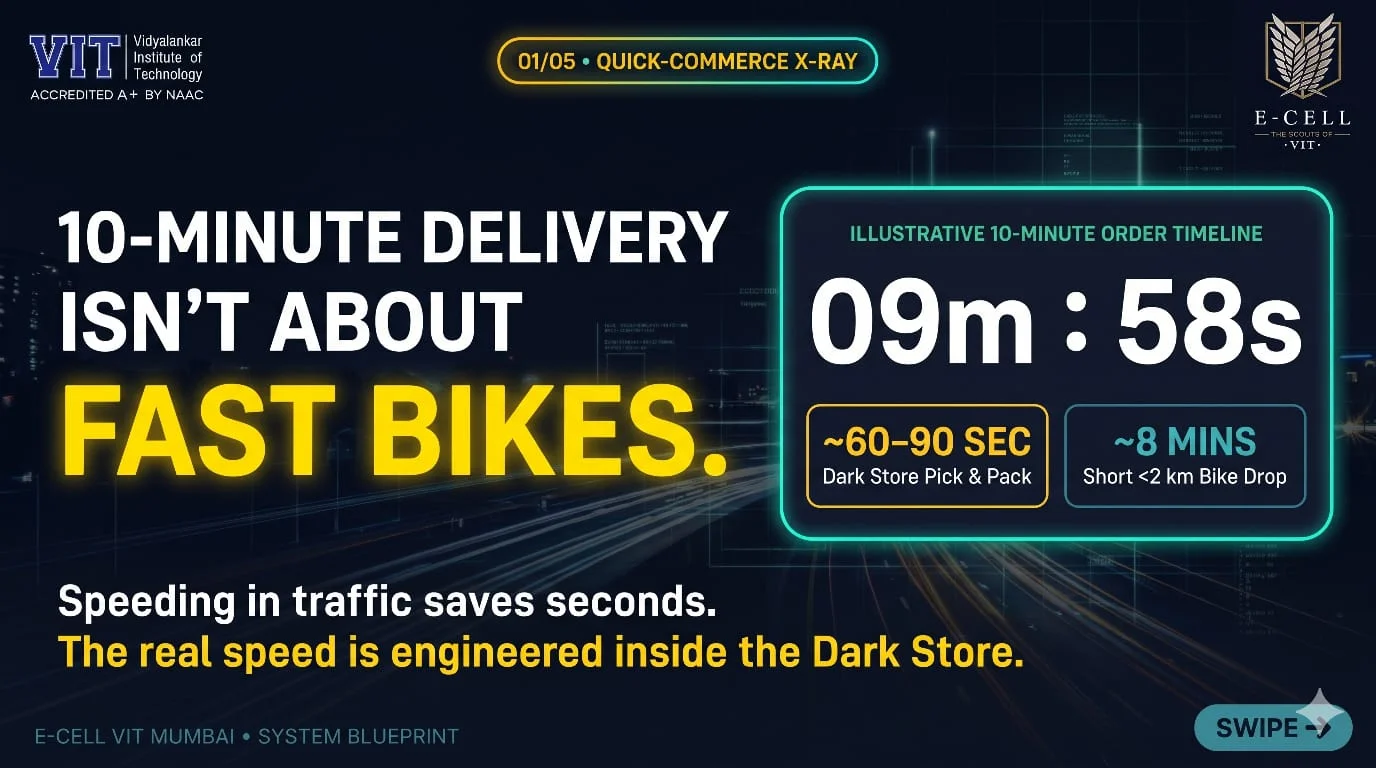
Everyone thinks 10-minute delivery happens because a rider zooms through Mumbai traffic at 80 km/h. Honestly, that’s a myth. Speeding through traffic barely saves any seconds. So where does the time actually go? Here’s how a typical 10-minute Blinkit or Zepto order breaks down (9 minutes 58 seconds in total): • 1 to 1.5 minutes: your order gets packed in a hidden local room. • About 8 minutes: an easy, short ride to your gate. The real magic happens before the bike even starts. What Is a Dark Store? Think of it as a supermarket where you can’t walk in. Blinkit and Zepto hide small rooms of around 2,000 sq ft inside neighborhoods across the city. Customers never enter them. They exist only to pack orders, fast. The numbers (2026 data) show how intense they are: • 1,400 to 2,100 orders per day at a single dark store. One Zepto store packs about 2,140 bags a day, and a Blinkit store about 1,425. • Workers seal each grocery bag in just 60 to 90 seconds. • 3,800+ dark stores across India: Blinkit runs 2,751 and Zepto runs 1,139. Almost every Mumbai neighborhood has one near your home. Now think about your study desk the night before an exam. You don’t keep your notes, pen and charger in three different rooms. You keep them right next to your hand so you don’t waste time walking around. Dark stores use three simple tricks to do the exact same thing. Trick #1: The “4-Step” Maggi & Milk Rule In a normal supermarket, milk and bread sit at the back so you have to walk past everything else on the way. A dark store flips that logic completely. Here’s why: 8 out of 10 orders ask for the same 200 items (milk, bread, Maggi, eggs). So those items sit on the front shelf, just 4 steps from the packing table, and can be grabbed in about 15 seconds. Rarely ordered products like masalas, cleaners and shampoos live on the back shelves, 12+ steps away, which costs roughly 45 extra seconds each time. The store’s packing table sits by the door. A worker grabs the item in 4 steps, hands the bag straight to the rider, and the rider is already waiting outside. The simple time math, per store, every day: Saving 45 seconds × 2,000 orders = 25 hours saved. That’s 25 hours of walking saved at one store, every single day, just by deciding where the shelves go. Trick #2: The 2 km Delivery Circle Every dark store is locked inside a strict 2 km circle. In Mumbai, think of separate circles around hubs like Wadala (where VIT sits), Dadar and Bandra. Each store only serves its own area. There’s a cost reason for this: Inside 2 km (the sweet spot): about ₹35 per order • The ride takes just 6 to 8 minutes. • One rider can carry 2 nearby orders, sometimes in the same building. • The store makes a profit. If a rider crosses 2 km: about ₹55 per order (a +57% cost jump) • The ride takes twice as long in traffic. • The rider can only carry 1 order. • It wipes out all the profit on a ₹150 Maggi order. That’s why your local dark store never delivers far away. It’s a cost wall, not a technical limit. Trick #3: The 6:45 PM “Mind-Reader” AI Ever seen a rider already parked outside your building gate at 6:45 PM? That’s not a coincidence. Here’s how the system works: 1. 1:00 PM (6 hours before you order): checks rain and cricket schedules. The app looks at Mumbai weather forecasts and 7:00 PM India cricket match timings, knowing thousands of people will crave evening snacks. 2. 4:00 PM (3 hours before you order): extra Maggi and chips move to the front. Before the rain starts or the match begins, dark store workers stock extra Maggi, chai, chips and cold drinks right next to the packing table. 3. 6:45 PM (15 minutes before you order): riders park outside your gate. The app sends riders to wait outside big apartment gates, so when you tap “Order” at 7:00 PM, your rider is already downstairs. In short, the app predicts your cravings before you do. The 10-Second Takeaway A smart room beats fast bikes. 10-minute delivery isn’t won on the road. It’s won inside the room, before the rider even starts the bike. Your Verdict Out of these three tricks, which one is the smartest 200 IQ move? • A. The 4-step shelf trick: keeping milk and Maggi 4 steps away to save 25 hours of walking per day. • B. The 2 km circle rule: never delivering past 2 km so rider cost doesn’t jump 57%. • C. The 6:45 PM “mind-reader” AI: parking riders outside your society gate before you even order. Drop A, B, or C in the comments, and follow E-Cell VIT Mumbai for weekly startup breakdowns. Sources: Economic Times and Fortune India (2026); Zepto 2026 rate card and ops data. #ECellVIT #VITMumbai #BuilderBlueprint #Blinkit #Zepto #QuickCommerce #StartupsIndia